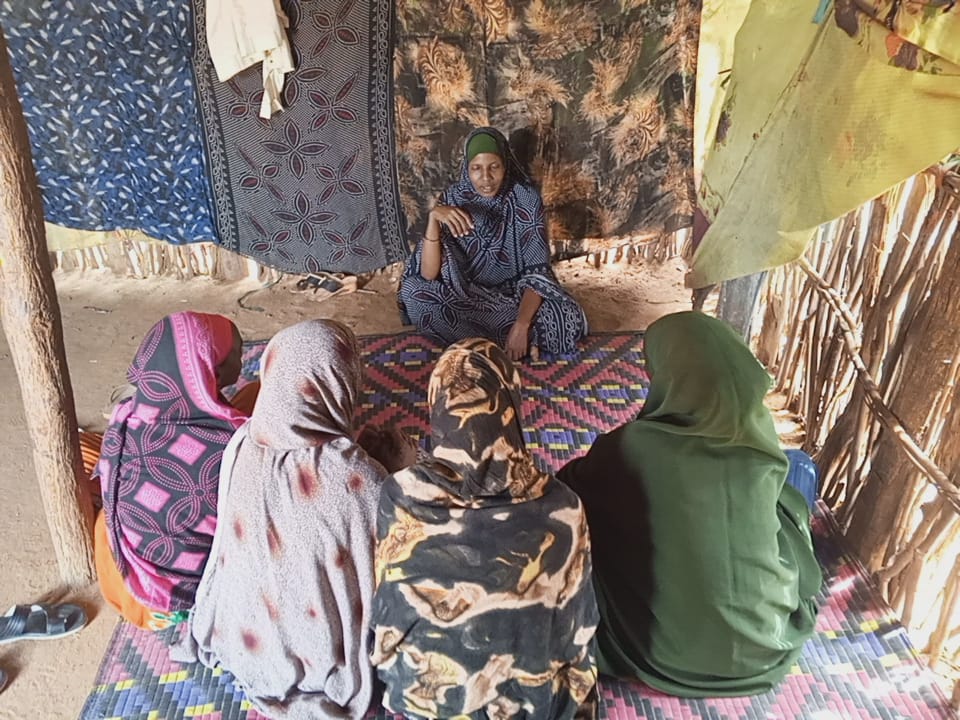
ashipae is fifteen and, like most girls in her corner of Wajir, had never had a room she could call her own until the Safe Space opened down the road from her homestead. The Adolescent Girls Initiative – Kenya (AGI-K) runs on a simple weekly rhythm: a couple of hours, one afternoon a week, in a room with a trained female mentor and a dozen or so girls from the same community — no brothers, no parents, no expectation to perform for anyone but themselves.
‘Nashipae’ is used here as a composite, representative name — the details reflect the pattern AGI-K mentors describe across many girls in the program, not a single disclosed individual. What the sessions describe is consistent: mentors move between life-skills discussion, health information girls rarely get elsewhere, and — every few weeks — a savings-group meeting where each girl records what she has put aside since the last session, however small the amount.
The cash transfer that comes with enrollment is conditional on staying in school, and for households weighing whether a daughter’s school fees are worth the cost against an early marriage proposal, that transfer has shifted the calculation more than any single conversation could. Alongside it, community dialogue sessions bring in parents, elders, and local leaders to talk openly about the norms — early marriage chief among them — that the program is trying to shift, so the change is not something imposed on girls alone but discussed with the people who make decisions on their behalf.
“Before, my father would have decided everything about my life without asking me. Now he asks what I think, because he sees I have my own money and my own plan.” That line, echoed in different words across many of the program’s community dialogue sessions, is the kind of shift mentors say is hardest to measure on a survey but easiest to notice in a room.
“Before, my father would have decided everything about my life without asking me. Now he asks what I think, because he sees I have my own money and my own plan.”
Population Council Kenya, working in partnership with the Wajir County Government, continues to track how girls in AGI-K cohorts fare on school retention, age at marriage, and financial confidence as the program scales across the county — evidence that will shape whether the same combination of mentorship, savings, and community dialogue is extended to neighboring arid counties facing similar pressures on girls’ futures.